


علماء الفلك يرصدون إشارة غامضة مقبلة إلينا من الكون المبكر
علماء الفلك يرصدون تدفّقات راديوية سريعة تحمل معلومات عن الكون في مراحلها المبكرة تعود إلى حقبة كان عمر الكون فيها 3 مليارات سنة فقط.
-
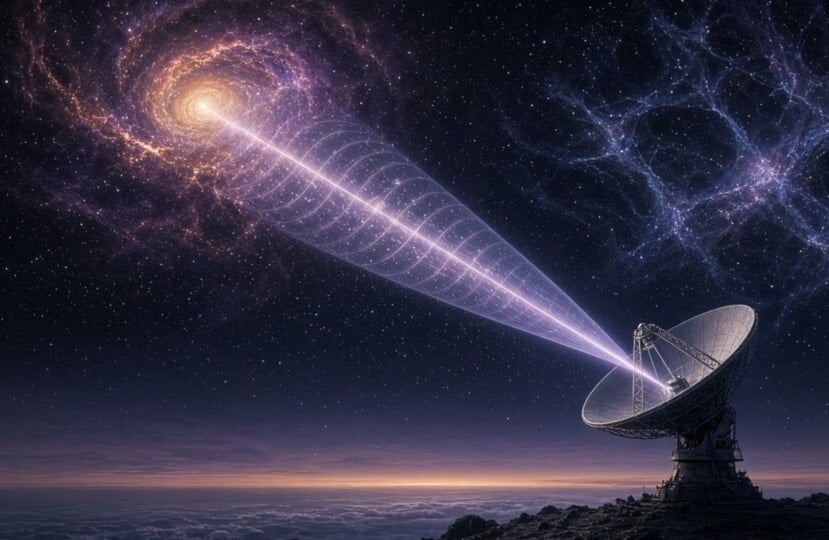
إشارة غامضة من بدايات الكون تصل إلى الأرض
رصد علماء الفلك دفقة راديوية سريعة قطعت مسافة استغرقت نحو 10 مليارات سنة قبل وصول إشارتها إلى الأرض، تحمل معلومات عن الكون في مراحله المبكرة.
ووفق ما ذكرته صحيفة The Independent البريطانية يعود هذا الرصد بالعلماء إلى حقبة كان عمر الكون فيها 3 مليارات سنة فقط (أي بعد الانفجار العظيم بـ 3 مليارات عام)، ليتجاوز هذا الاكتشاف ضعف الرقم القياسي السابق.
تمت عملية الرصد الأولي للدفقة التي حَمَلت اسم "FRB 20240304B" بواسطة تلسكوب "MeerKAT" في جنوب أفريقيا عبر مشروع "MeerTRAP".
A flash of radio waves from a young galaxy 3 billion years after the Big Bang is lighting up 80% of the universe's history. @themiyan @manishacaleb @Sydney_Uni https://t.co/yoYZX4405y
— The Conversation - Australia + New Zealand (@ConversationEDU) October 8, 2026
واستعان الفريق البحثي لاحقاً بتلسكوب "جيمس ويب" James Webb الفضائي لتحديد المجرة المضيفة بدقة.
أبرز معطيات ونتائج الدراسة (المنشورة في مجلة "Science"):
خصائص المجرة المضيفة: وتبيّن أنّ الإشارة انطلقت من مجرة صغيرة الحجم، فقيرة بالعناصر الكيميائية الثقيلة، لكنها تشهد نشاطاً كبيراً ومكثفاً في ولادة وتكوين النجوم الجديدة.
Webb measures distance to farthest fast radio burst, suggesting origin Record breaker dates back to just 3 billion years after the Big Bang Imagine a cosmic flash lasting barely a millisecond—intense enough to be spotted from across the Universe, then gone forever. Since their discovery in 2007, fast radio bursts (FRBs) have remained one of astronomy’s deepest puzzles: brief, powerful radio flashes from the distant cosmos whose origins are still uncertain, largely because most are seen only once. Using the NASA/ESA/CSA James Webb Space Telescope, astronomers have now traced the most distant FRB ever detected—FRB 20240304B—to its host galaxy. Detected by South Africa’s MeerKAT telescope, the burst’s radio signal suggested an extreme distance. Ground-based telescopes saw nothing at the precise location, but Webb’s Near-Infrared Camera and Spectrograph revealed a faint galaxy and measured its redshift at 2.148. That places the event just 3 billion years after the Big Bang, when the Universe was only about a quarter of its current age. The signal traveled more than 10 billion years to reach us, more than doubling the previous FRB distance record. The host itself was a surprise: a tiny dwarf galaxy roughly 1,000 times less massive than the large, star-forming systems that usually host FRBs, yet vigorously forming stars during “cosmic noon,” the peak era of star formation in the Universe. Most of its stars appear to have formed within only about 30 million years. This youthful, metal-poor environment favors one leading explanation—that at least some FRBs come from young, highly magnetized neutron stars (magnetars) created in recent supernovae—over the alternative idea of ancient mergers of older neutron stars, which would require billions of years. Beyond solving (or at least constraining) the origin puzzle, the burst also acted like a cosmic flashlight, revealing structures along its path, including a previously unknown galaxy cluster and the nearby Virgo Cluster. Image Credit: NASA, ESA, CSA, STScI, T. Nanayakkara (USYD). Image Processing: J. DePasquale (STScI)
— Black Hole (@konstructivizm) October 10, 2026
مصدر الإشارة المحتمل: تُعزز خصائص المجرة فرضية أنّ الدفقة نشأت عن "نجم مغناطيسي فتي" (Magnetar)؛ وهو نجم نيوتروني ذو مجال مغناطيسي هائل يتشكّل بعد انفجار النجوم الضخمة (المستعر الأعظم). ورغم ذلك، لا يزال احتمال تفاعل أو اندماج نجوم نيوترونية قديمة قائماً كبديل لتفسير الظاهرة.
القيمة العلمية للاكتشاف: تُتيح هذه الدفقة العابرة للمسافات فرصة استثنائية لدراسة "المادة المنتشرة بين المجرّات" والتي يصعب رصدها مباشرة؛ إذ إنّ تحليل التغيّرات التي طرأت على الإشارة خلال رحلتها عبر الفضاء يساعد العلماء على فهم توزيع المادة وتطوّر المجرّات في مراحل الكون المبكرة.


